Chronic pain is one of the most prevalent and debilitating health conditions worldwide, affecting hundreds of millions of people and representing an enormous burden on individuals, families, and healthcare systems. For many patients, conventional treatments — analgesic medications, physical therapy, nerve blocks, and even surgical interventions — fail to provide adequate, lasting relief. These individuals often find themselves trapped in a cycle of persistent pain, reduced mobility, psychological distress, and diminished quality of life with no clear path forward.
Spinal Cord Stimulation (SCS) has emerged over the past five decades as one of the most effective and evidence-based interventions for carefully selected patients with refractory chronic pain. By delivering precisely calibrated electrical impulses to the dorsal columns of the spinal cord, SCS modulates pain signaling pathways and can achieve sustained pain relief that fundamentally transforms patients' daily lives. At NuRaX Care and Research Center, SCS represents a cornerstone of our multidisciplinary approach to complex, treatment-resistant pain conditions.
How Spinal Cord Stimulation Works
The mechanism of SCS is rooted in the Gate Control Theory of pain, first proposed by Melzack and Wall in 1965, which established that electrical stimulation of large sensory nerve fibers in the spinal cord can effectively "close the gate" to pain signals traveling toward the brain. Modern SCS builds significantly upon this foundational concept. When the SCS system delivers electrical pulses to the posterior (dorsal) columns of the spinal cord, it activates inhibitory interneurons and modulates the activity of wide dynamic range neurons in the dorsal horn, suppressing the transmission of nociceptive (pain) signals ascending to the brain.
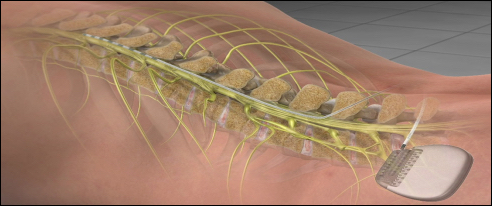
Contemporary SCS systems consist of three main components: slender electrode leads that are placed in the epidural space adjacent to the dorsal columns, a small implantable pulse generator (IPG) inserted beneath the skin of the abdomen or buttock, and an external patient controller that allows individuals to adjust stimulation within programmed parameters. Advanced waveform technologies — including high-frequency stimulation (10 kHz), burst stimulation, and differential target multiplexed stimulation — have dramatically expanded the therapeutic repertoire, producing significant pain relief without the paresthesia (tingling sensation) historically associated with conventional SCS.
Conditions Treated with SCS
SCS has demonstrated efficacy across a broad spectrum of chronic pain conditions. The strongest evidence supports its use in:
- Failed Back Surgery Syndrome (FBSS): Persistent or recurrent pain following spinal surgery, often involving both back and leg pain, for which SCS shows superior long-term outcomes compared to reoperation or continued medical management.
- Complex Regional Pain Syndrome (CRPS): SCS is considered a first-line interventional therapy for CRPS Types I and II, with multiple randomized controlled trials demonstrating substantial and durable pain reduction.
- Diabetic Peripheral Neuropathy: Painful neuropathy resulting from diabetes-related nerve damage responds well to SCS, particularly high-frequency and burst waveforms, with patients reporting significant reductions in burning, shooting, and allodynic pain.
- Refractory Angina: For patients with coronary artery disease who are not candidates for revascularization, SCS reduces angina frequency and severity by modulating cardiac pain afferents.
- Peripheral Vascular Disease: SCS improves limb perfusion and reduces ischemic pain in patients with critical limb ischemia who are not surgical candidates.
- Post-herpetic Neuralgia: Chronic burning and allodynic pain following shingles can be significantly reduced with SCS when pharmacological management has proven inadequate.
The Implantation Process: Trial Before Commitment
A defining and clinically valuable feature of SCS that distinguishes it from most surgical pain interventions is the ability to conduct a reversible trial stimulation period before permanent implantation. The SCS process unfolds in two stages.
During the trial phase, which typically lasts five to ten days, temporary electrode leads are placed percutaneously in the epidural space under fluoroscopic guidance while the patient remains conscious. An external trial stimulator is connected to the leads and worn outside the body. The patient then returns home and assesses the impact of stimulation on their daily activities and pain levels. A successful trial is generally defined as achieving at least 50% pain reduction; many patients experience significantly greater relief. This trial period is critical because it allows both the patient and clinical team to objectively evaluate efficacy before proceeding to permanent implantation.
If the trial is successful, the permanent implantation proceeds in a minimally invasive outpatient or short-stay surgical procedure. The trial leads are replaced with permanent leads, and the IPG is implanted subcutaneously. Modern rechargeable IPGs have a lifespan of fifteen years or more, minimizing the frequency of battery replacement procedures.
The trial period is one of SCS's greatest clinical advantages — it transforms a complex, subjective decision about chronic pain management into an objective, evidence-based evaluation based on the patient's own lived experience.
Who Is a Candidate for SCS?
Careful patient selection is paramount to achieving excellent SCS outcomes. At NuRaX, our multidisciplinary team evaluates candidacy based on the following criteria:
- Chronic pain of appropriate etiology: The patient's pain condition must be one with established evidence of SCS efficacy, and the pain should have been present for at least three to six months.
- Failure of conservative treatment: Adequate trials of medications, physical therapy, and less invasive interventional procedures must have been completed without sufficient benefit.
- No active infection or coagulation disorder: Medical contraindications must be absent to ensure surgical safety.
- Psychological screening: A comprehensive psychological evaluation identifies conditions such as untreated depression, anxiety, or opioid dependence that may reduce the likelihood of successful outcomes.
- Realistic expectations: Patients must understand that SCS is a pain management therapy, not a cure, and must be prepared to engage with the ongoing programming and follow-up that optimizes outcomes.
Clinical Outcomes and Evidence Base
The evidence base supporting SCS has expanded dramatically over the past decade. Multiple randomized controlled trials, systematic reviews, and large registry studies have consistently demonstrated:
- 50–70% or greater pain reduction in 60–70% of well-selected patients at two years post-implant
- Significant improvements in functional capacity and ability to perform daily activities compared to continued medical management alone
- Reduced opioid consumption of 30–60% in long-term follow-up studies, with important implications for opioid-related morbidity
- Improved psychological outcomes including reduced depression, anxiety, and sleep disturbance — dimensions of chronic pain that medications often fail to adequately address
- Superior cost-effectiveness over a five-year horizon compared to continued medical management, reoperation, or intrathecal drug delivery for FBSS and CRPS
Innovation at NuRaX: Next-Generation SCS Technologies
At NuRaX Care and Research Center, we are committed to offering patients the most advanced SCS technologies available. Closed-loop or "adaptive" SCS systems now monitor neural signals from the spinal cord in real time and automatically adjust stimulation parameters to maintain consistent therapeutic coverage as the patient moves, changes position, or shifts their activity level. This represents a fundamental advance over older open-loop systems that required manual programming adjustments to account for postural changes.
Dorsal root ganglion (DRG) stimulation, a targeted variant of conventional SCS, allows precise neuromodulation of specific sensory nerve cell clusters supplying focal pain areas — particularly in the foot, knee, groin, and chest — that are difficult to cover with traditional paraspinal lead placement. Our specialists are trained in the full range of SCS platforms and waveform options, enabling truly individualized treatment selection.
If you are living with chronic pain that has not responded to conventional treatment, we encourage you to contact our team at NuRaX to explore whether spinal cord stimulation could offer you a new path to lasting relief and restored quality of life.
N
NuRaX Editorial Team
NuRaX Care & Research Center
Our editorial team comprises neurologists, neurosurgeons, and clinical researchers dedicated to providing accurate, accessible information about neuromodulation therapies and the latest advances in neurological care.

.jpeg)